What is CPL Filter ? How does it Work ?
A CPL (or Circular Polarising Filter) is a filter often placed in front of a camera lens in order to darken skies, manage reflections, or suppress glare from surface of lake, sea or glossy objects.
The lights comes from sun or artificial light source are usually non-polarised, however, when they reflects from (non-metal) glossy surface, the reflected light becomes partially polarised, this effects is maximum at Brewster’s angle (the angle differs depending on the density of the medium, The Brewster’s angle for glass is about 56°, for air-water is about 53°).
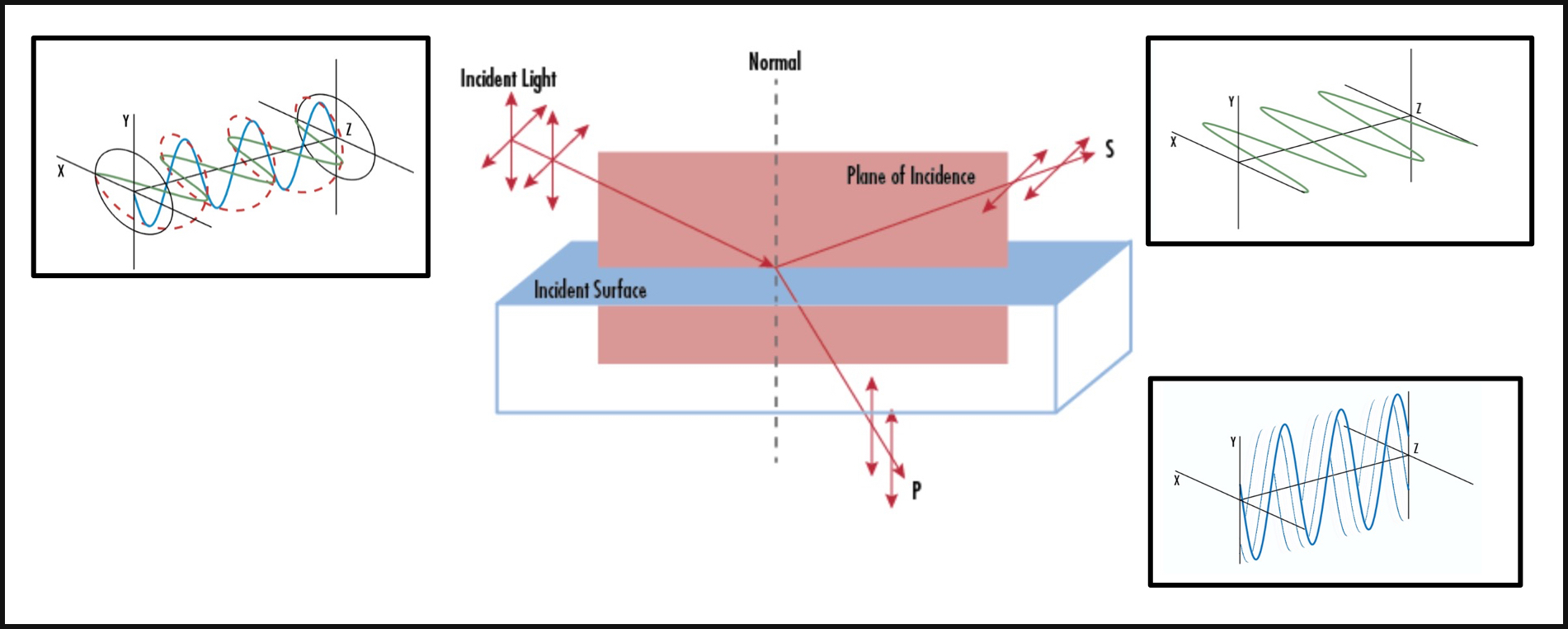
(image is composed via images from Edmund Optics: Link)
Sine reflections through glossy object tends to become partially linearly-polarised, a CPL filter can be used to abort such reflected light, by rotating the filter (the effect of “elimination of reflection” is strongest when the grating of the filter is 90° perpendicular to the polarised light).
(image is composed via images from Edmund Optics: Link)
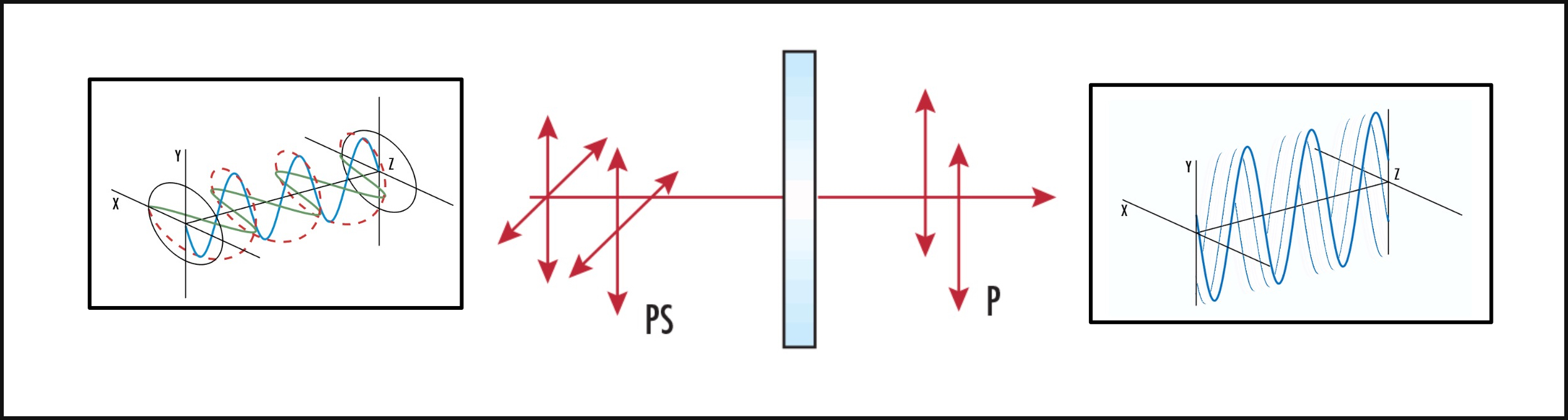
When used on difference scenarios ?
Glossy Surface
(dealing with reflection, removing S-polarised light) You can remove the reflection from the glossy surface such as Glass or Leaf:

(example image from Wikipedia: Link)
Transparent Object
(dealing with refraction, removing P-polarised light) You can remove the refraction through the transparent objects such as Sky:
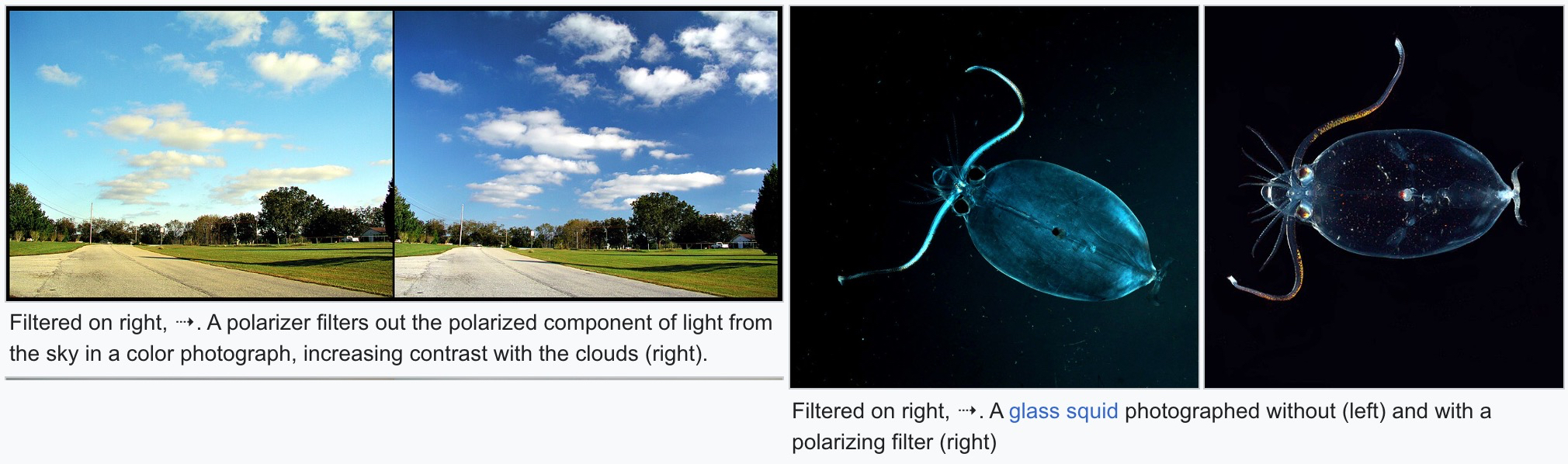
(example image from Wikipedia: Link)
Matt, Frosted, Layered Surface
When you’re encountering these kind of surface, since they’re not specular reflection (diffuse reflection), some of the scattered light that has lost polarization, hence a CPL does nothing to those light components:
Glossy surface with fingerprint and dust, or micro-scratches
Glass with matt finish for privacy protection
Aircraft windows
(which contains: two layout of window (acrylic plastic that is often scratched)
with curved geometry, with air gap between the window)
Why CPL filter works especially poor at removing the airplane window’s reflection, and sometimes even creating some rainbow effect ?
When light hits aircraft glass, it splits into multiple reflection paths:
- (A) Surface (air → glass) reflection • Happens at the outer surface • Strongly polarized (especially near Brewster’s angle) • This is what a CPL removes best
- (B) Internal reflections (glass → air → glass) • Light reflects inside the glass layers • Each bounce changes polarization direction
- Result: partially or randomly polarized light, A CPL filter can remove (A), but only part of (B).
Metal (Coated) Surface
Many “metal glossy” surfaces such as metallic layers or conductive or mirror-like coatings metals reflect un-polarised light, which cannot be removed by a CPL (this ie because metal reflects un-polarised lights), for instance:
Stainless steel surface
Chemically strengthened glass
Mobile screen / display
(which contains: touch sensor layers + OLED/LCD polarizers + anti-reflective coatings
How to use CPL filter ?
First off, after a about a weeks of travelling with CPL filter always-on, my conclusion and suggestion is that you always lock the auto exposure (using AEL button) before you start adjusting the CPL filter. This is because the modern camera are often quick with metering adjustment, once you start rotating the CPL filter to remove some of the (polarised) light from the scene, the camera may immediately determine it is too dark, and raise the exposure of the scene, making it hard for us to tell the difference (the auto exposure adjustment hide the effect).
To use CPL filter, simply attach before the front element of your lens, and rotate while observe the surface of your attention, until you see the reflected light goes away (e.g. water becomes more transparent); The optimal position (where the filter have the most effect) and worst position, are usually 90° perpendicular off each other.
Please note that even for the same scene, for each different position you stand, you might need to adjust your CPL filter position, as your angle with the surface may change. If you are shooting from the same angle to the surface, only adjusting your camera from portrait to landscape, you can hold the CPL filter (such that its rotational angle to the surface remain constant) while rotating the camera+lens only.
Also to conclude the previous section, you should also keep in mind that the CPL filter works poorly when:
- You’re not near the Brewster’s angle (50° ~ 60°), especially
- You’re shooting almost directly at the light source (looking at the sun)
- You’re shooting directly away from the light source (the sun is directly behind you)
- You’re shooting at a metallic or matt surface (fingerprint, dust also counts)