Why should I use HSS ?
To begin with, we must revise how the flash works:
When the flash is triggered (either when front curtain fully opens, or just before rear curtain starts drops), it sends a single, instantaneous burst of light (with the percent of energy that you set on the flash, usually from 1/256 to 1/1 percent), and this happens in usually less than 5 ms OR 1/200 second (this usually differs depending on the manufacture of the flashlight, and the power level; For instance, the Sony HVL-F60RM II have a flash duration in less than 2.8ms OR 1/350 second at 1/1 Manual Power Level).
Please note that: this burst of light is NOT a perfect uniform light of the same luminosity within the burst duration, the power of the burst is not even across the whole triggering cycle (put simply, within the 5ms flash duration, the bulb in it will start from black and slowly increase its brightness until its peak, and then drop back to black again)
When your shutter speed is slower than the speed/duration of the light beam (usually ≥1/250s), there won’t be any issue, as the front/back curtain will have enough time to drop/raise, thus the camera sensor will have enough time to be lit as an whole by the flash light.
When you shutter speeds is faster than the speed/duration of the light beam (usually ≤1/250s), then the interval between your front and back curtain will become a narrow gap (this will get smaller and smaller as your shutter speed become faster). And considering the burst of light will last for a duration for longer amount of time, its peak brightness in the purse will only be captured by certain area of the sensor (but not the whole sensor).
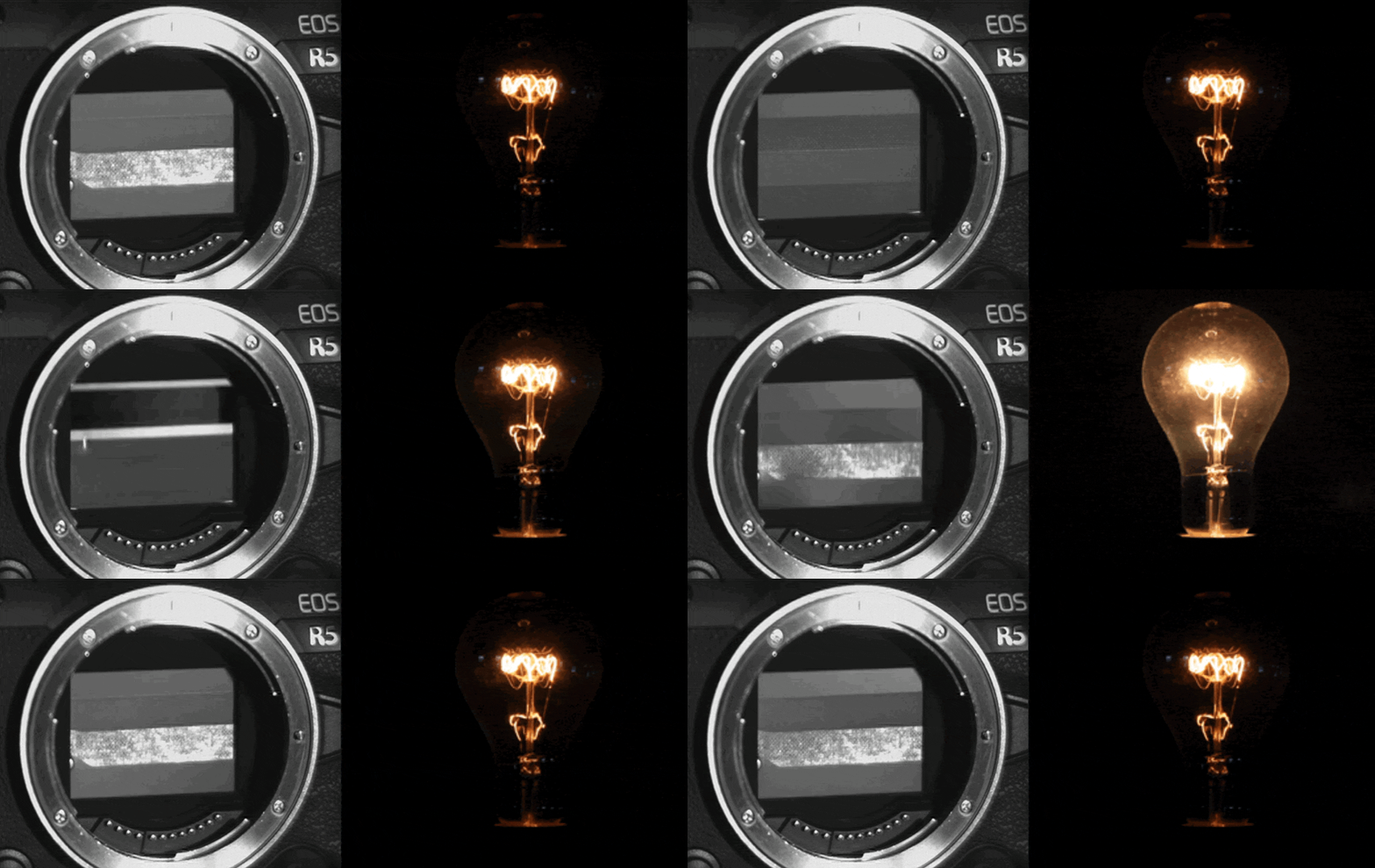
(image from: makeagif.com and Pinterest)
As a result, within a single flash burst cycle, some area of the camera sensor is be exposed to the “brighter” bulb, and some exposed to the “darker” bulb, as a result you will get some black or white banding effect in your image: (I can’t actually re-produce this effect on my Sony A7 camera, as it prevents the shutter speed to go below 1/250 second when a flash light is attached + no HSS is enabled)
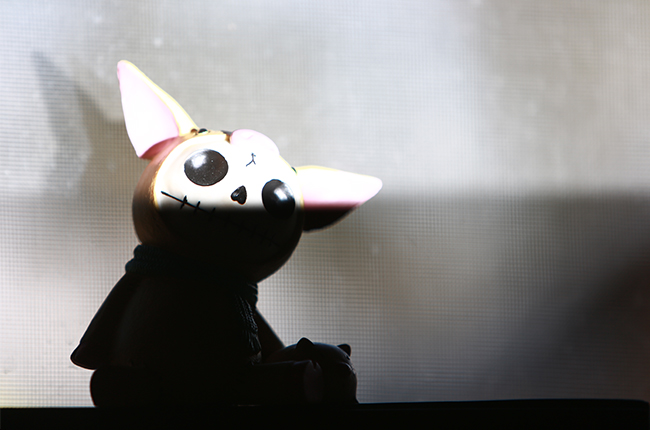
(image form: SLR Lounge)
⬆️ This is not what I originally imagined, I originally thought that:
flash’s speed will automatically adjust, and be roughly similar to that of the shutter speed– WRONG ! I confused myself to think power level is the same as shutter speed !flash light have the same brightness throughout the whole duration– WRONG ! Because a flash starts by ionizing the gas in its bulb, which rapidly increases in brightness to a peak before falling off as the capacitor discharges. The light output is not perfectly constant and uniform; it follows a curve where the intensity peaks and then declines.because i though the light is perfectly even, each pixel strip on the sensor should be exposed to the same amount of the light, no matter what the shutter speed is, there should be no banding effect– WRONG !
This is where we’ll need HSS (High-Speed-Sync), when this mode is turned on, instead of a single burst of light, the flash sends multiple burst of light at high speed (frequency), such that at all the shutter positions, the sensor exposed beneath it get the same amount of lighting from flash:
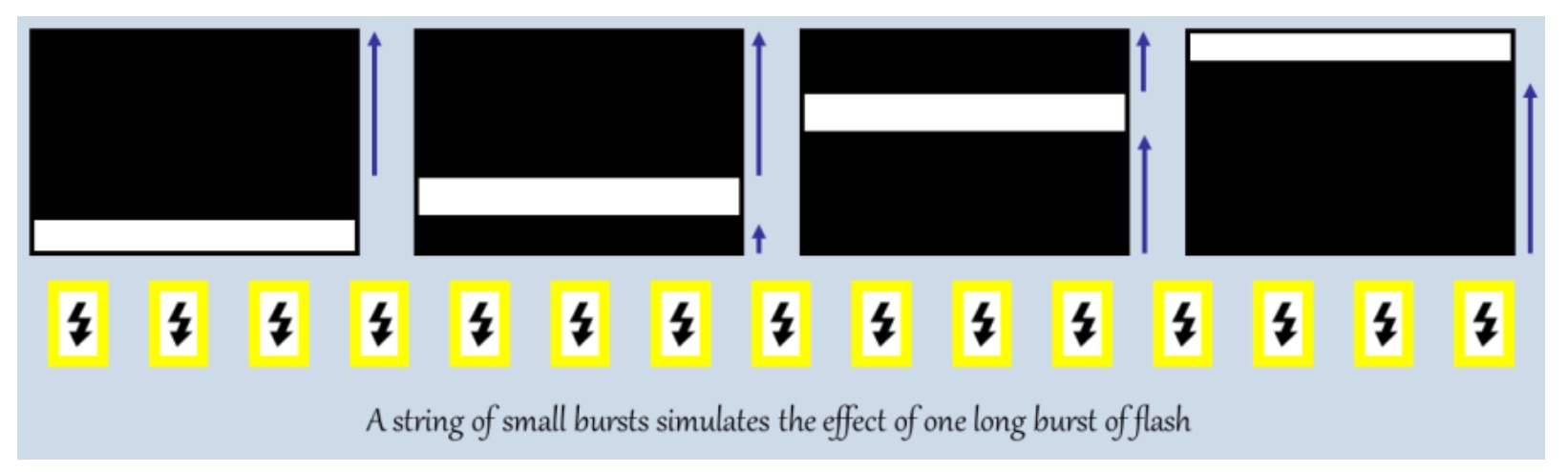
(image from: Sony Support - What is High Speed Synchronization (HSS)?)
This enabled you to use flash in scenarios where you do not want to have slow shutter. We will explain when to use HSS in the next section.
Also here’s a few exceptions / difference on how the discharge profile (rise and decay of the brightness) could different camera bodies and sensor:
On global shutter sensor like the A9 III have, this won’t be an issue, because there is no physically shutter involved in this process, the whole sensor will capture the burst of light flash produce at the same time.
On the aperture shutter like the Ricoh GR III I am having, this effect is less annoying but still noticeable, that when the shutter speed is faster than 1/250 second, the area around the edge of the image will start appear darker comparing to that of centre.
When should I use HSS ?
Put simply, as mentioned earlier, when you don’t want to have slow shutter speed, and this may attributed towards the scenario you’re shooting in:
To capture motion: this one is simple, and straightforward, when you want to freeze motion, such as table tennis ball travelling at 100km/h, or snowboard racer in mid of the air, without having the motion blur, you’ll want to have a faster shutter. And this holds true even without a flash light attached.

(image from: Sina-News-CN)
To reduce the ambient light: if you have used the flash for a fair amount of time, you must have known now that the adjusting the Aperture and ISO don’t have an effect of the proportion of “ambient lighting” vs “flash lighting”, however, adjusting the Shutter-Speed will ! When the power level of flash stays constant, the slower the shutter speed, the more percentage of ambient light. Me personally, I usually benefit from the opposite of this, that is when shooting portrait photo under sunlight, I use fast shutter speed to reduce the percentage of ambient light, to darken the background, and makes the people/object closer in front of the camera stand out.

(image from: DCFever.com - Raymond Kam)
When shouldn’t I use HSS ?
Something to be aware is that the HSS can significantly reduce your flash’s maximum output power, the faster your shutter speed is, the less the max power it will be able to provide.
For example, for Sony HVL-F60RM2, the flash without HSS turned on outputs maximum power at GN 60 (Flash coverage setting 200mm/STD flash distribution, IS0100 • m). Below is a table of how max output drops when HSS-on under different shutter speed:
| Shutter | GN | % of Energy | **% of Light Intensity ** | Loss (EV Stops) |
|---|---|---|---|---|
| >1/250 (HSS-off) | 60 | 100% | 100% | 0 EV |
| =1/250 (HSS-on) | 60 | 100% | 100% | 0 EV |
| =1/250 (HSS-on) | 16.7 | 27.8% | 7.7% | −3.7 EV |
| 1/500 (HSS-on) | 11.8 | 19.7% | 3.9% | −4.7 EV |
| 1/1000 (HSS-on) | 8.4 | 15% | 2.0% | −5.7 EV |
| 1/2000 (HSS-on) | 5.9 | 9.8% | 0.97% | −6.7 EV |
| 1/4000 (HSS-on) | 4.2 | 7% | 0.49% | −7.7 EV |
| 1/8000 (HSS-on) | 3.0 | 5% | 0.25% | −8.6 EV |
(*% Energy = (GN-current/GN-full) AND % of Light Intensity = (GN-current/GN-full)^2 (due to inverse-square law))
Hence, in scenario where you need the full power output of the flash, and don’t need to reduce the shutter speed to below 1/250 second, then it may be a better choice to not use HSS, but to install a ND filter instead.